
 Likes:
 Reply With Quote
FAQ new Primo 18w
Starting with version 9.35.2, the new Primo standard comes with 18 default notification types from the manufacturer.
This encoding is for all versions starting with 9.35.2. Unless there are changes, there will be extensions to 32 types in UX speedcam.ID0 = 1 / 32 "StaticCamera",
ID1 = 5 / 33 "MobileCamera",
ID2 = 2 / 34 "CameraInTrafficLight",
ID3 = 4 / 35 "SectionCamera",
ID4 = 3 / 36 "RedLight",
ID6 = 6 / 38 "RailwayCrossing",
ID7 = 7 / 39 "BusLane",
ID8 = 8 / 40 "BlackSpot",
ID9 = 9 / 41 "SchoolZone",
ID10 = 10 / 42 "UrbanArea",
ID11 = 11 / 43 "RedLightTrap",
ID12 = 12 / 44 "TollBooth",
ID13 = 13 / 45 "Hospital",
ID14 = 14 / 46 "FireStation",
ID15 = 15 / 47 "ChargeZone",
ID22 = 22 / 54 "SpeedBump",
ID23 = 23 / 55 "NoParkingZone",
ID31 = 31 / 63 "DangerousArea"
Primo standard has changed from 16 to 18 types, with all the ensuing implications. This may be reflected in the future when using speedcam.spc.
Welcome guest, is this your first visit? Click the "Create Account" button now to join.


Results 271 to 280 of 363
Thread: iGO Speedcam (DISCUSSION)
-
28th September 2025, 07:33 PM #271SUPER MODERATOR


- Join Date
- Oct 2019
- Location
- Belarus
- Posts
- 3,786
- Rep Power
- 2751
 About changing the encoding, why 32 when everyone is used to 1. For various programs that are adapted to 1 code, this is important, but for the content/speedcam folder, it does not matter. Since iGO reads all codes with period 32, there is a table of periods at the beginning [Only registered and activated users can see links. ] Therefore, for iGO, it does not matter which period is used in speedcam.txt, 1 or 32, as this substitution is built into all iGO navigation programs. We assume that the 32 code works on iGO Primo, iGO nextGen, and iGO Luna. It does not work on ?iGO8 v8.3?, and I do not have the opportunity to verify this.Do you think Andrey Form didn't think about how he could earn a few pennies? Why do you think he changed everything in speedcam? Especially for comfortable or non-tech-savvy people. Contact him because for a small fee, he gives you the entire speedcam archive, saving you 30-40 minutes of your life.
Another question is about iGO8 v8.3 and the use of speedcam.spc files. The fact is that spc is a primo encoding, and there can be any alert types from 1 to 15 + 31, which are incompatible with iGO8 v8.3
This is what he writes @Andron66 in 2011 year - 21.04.2011
Here's the thing, even back in 2011 the encoding for iGO was 3 digits, the first 5 types - 192, 193, 194, 227, 68.Let me explain...
Initially, iGo8 had five types (from the top, in order: 192, 193, 194, 227, 68). Then, as the program evolved, it became possible to increase their number to... We settled on 15, adding cameras 197 through 206 (these aren't really speedcams, but rather warnings), calling them "Extended" or DA (Driver Alerts), by analogy with the Driver Alerts signs that appeared in the program much later (files with the .fda extension). As it turned out, the introduction of these types was more than successful. Firstly, it became possible to add and edit these warnings ourselves, and secondly, it allowed for more extensive warning settings (voice-sounds-distance-direction). This is the format of the databases for the 8 and Primo, with modifications for the 8 speedcam databases. With the release of Primo, the developer introduced an additional 27 types (in addition to the first 5), bringing the total to 32 (types 197-223). As a result, we had a conflict between types 197-206 (the extended type in iGo8). This is where our "experts" began their shenanigans, swapping speedcam lines. Although, as you can easily see, types 208-222 are unused in Primo itself. WertVRV's skin left the Primo types alone, instead adding an extended type for the empty 208-215 (Danger Zone coincided with Primo's type 223). Now it's clear why only 24 types are used in skins? Types 197, 216-222 are "dummy" types, i.e., "reserve" :D (32-8 = 24).
_ID0 = 1_or_64_or__96_or_128_or_160_or_192_or_224 - 32
_ID1 = 5_or_65_or__97_or_129_or_161_or_193_or_225 - 33
_ID2 = 2_or_66_or__98_or_130_or_162_or_194_or_226 - 34
_ID3 = 4_or_67_or__99_or_131_or_163_or_195_or_227 - 35
_ID4 = 3_or_68_or_100_or_132_or_164_or_196_or_228 - 36
@Stanislavovoch 29.10.2008
Here's what we were able to expand in iGO 8.3: @Stanislavovoch 29.10.2008Basic - standard (common to ALL versions of iGO, Primo, Amigo, etc.); are new codes for txt database files, although iGO still accepts old codes (1....5) from txt databases.
ID0 = 1 /192 CD "Static" "Stationary camera"
ID1 = 5 /193 CD "Mobile" "Mobile ambush" (no speed recording)
ID2 = 2 /194 CD "Redlight" "Camera built into a traffic light"
ID3 = 4 /227 CD "Section" "Speed measurement on a section"
ID4 = 3 /68 CD "Redlight Only" "Red light monitoring" (no speed recording)
Now let's talk about how iGO Primo has expanded: @Stanislavovoch 31.12.2014Extended - non-standard
ID5 = 5 / 197 DI "Railroad" "Crossing" (no speed limit, always in both directions)
ID6 = 6 / 198 DI "Give Way" "Give Way" (no speed limit) (corresponds to sign 2.4 "Give Way") voiceover: "Give Way"
ID7 = 7 /199 CD "FixMobil" "Mobile Ambush" (with speed limit, essentially an alternative to CD 05 "Mobile")
ID8 = 8 /200 DI "Speed Breaker" "Speed Bump" (corresponds to sign 1.17 "Speed Bump") voiceover: "Speed Bump Ahead"
ID9 = 9 /201 DI "Children" "Children" (no direction or speed limit), indicates areas where pedestrians, children, and other living creatures congregate
ID10 = 10 / 202 DI "Dangerous Turn" "Dangerous Turn" (no speed limit) (corresponds to sign 1.12.1 "Dangerous Curves" voiceover: "Dangerous curve ahead"
ID11 = 11 / 203 DI "Tunnel"
ID12 = 12 / 204 DI "Dangerous Way" (corresponds to sign 1.33 "Other hazards") voiceover: "Dangerous section ahead." Used to warn of potholes, poor road conditions, and repair work.)
ID13 = 13 / 205 DI "POI" (no speed or direction) voiceover: "POI of interest ahead"
ID14 = 14 / 206 CD "RPS Post" voiceover: "Traffic police post ahead"
speedcam.spс correctly notifies starting with Primo versions:Extended - standard Primo
ID5 = ----------------------------
ID6 = 6 / 198 Railway crossing
ID7 = 7 / 199 Bus Lane Camera
ID8 = 8 / 200 High Accident Zone
ID9 = 9 / 201 School Zone
ID10 = 10 / 202 Town Entry Point
ID11 = 11 / 203 Red Light and Speed Camera
ID12 = 12 / 204 Toll Booth
ID13 = 13 / 205 Hospital, Ambulance
ID14 = 14 / 206 Fire Station
ID15 = 15 / 207 Congestion Charge Zone
ID31 = 31 / 223 Dangerous way
Primo 1.0 (exe version - 8.5.9.x)
Primo 1.1 (exe version - 8.5.11.x)
Primo 1.2 (exe version - 9.2.1.x)
Primo 2.0 (exe version - 9.6.x)
Primo 2.4 (exe version - 9.6.13)Last edited by Andrey Form; 29th September 2025 at 09:06 AM.

[Only registered and activated users can see links. ]
[Only registered and activated users can see links. ]
[Only registered and activated users can see links. ]
[Only registered and activated users can see links. ]
[Only registered and activated users can see links. ]
[Only registered and activated users can see links. ]
©AF_2020-26
-
2nd October 2025, 08:59 AM #272SUPER MODERATOR
- Join Date
- Oct 2019
- Location
- Belarus
- Posts
- 3,786
- Rep Power
- 2751
[Only registered and activated users can see links. ]
[Only registered and activated users can see links. ]
[Only registered and activated users can see links. ]
[Only registered and activated users can see links. ]
[Only registered and activated users can see links. ]
[Only registered and activated users can see links. ]
©AF_2020-26
-
19th October 2025, 02:54 PM #273SUPER MODERATOR
- Join Date
- Oct 2019
- Location
- Belarus
- Posts
- 3,786
- Rep Power
- 2751
Ai
Question for artificial intelligence: "What are the differences between the iTruck and Truck speedcam?"
And the answer:
Of course, he took the original information from the forum, but it is interesting that he made his own conclusions.The difference between the iTruck speedcam and the Truck speedcam lies in the source of the speed data to which the navigation program responds. This is a hybrid version created by enthusiasts for iGO NextGen to address the shortcomings of the standard handling of speed limits for trucks.
Speedcam Truck (standard version)
Map dependency: This version relies entirely on speed data stored in maps (HERE, TomTom).
Issues:
Incorrect alerts: If there is no speed information in the map for the section of road where the camera is located, no alert will be issued. For example, if a truck leaves a highway with a 90 km/h speed limit and enters a built-up area with a 60 km/h speed limit, iGO will continue to display 90 km/h until the vehicle enters the section with the new speed limit.
Map errors: Maps may contain inaccurate speed data for trucks, resulting in incorrect alerts. Result: Less accurate speed limit information, especially when limits change frequently.
Speedcam iTruck (Hybrid Version)
Data Sources: This version uses a hybrid approach:
50% from the Speedcam database: Speed limit data is taken from the database itself (OSC).
50% from maps (HERE/TomTom): Speed limit data is taken from maps, as in the standard version.
Problem Solving:
Accuracy: iTruck displays speed limits more accurately because it uses two sources simultaneously. If information from one source is missing or incorrect, the second source can supplement or correct it.
Dynamism: Data blending solves the problem of inaccurate speed display when changing road sections with different limits.
Result: A more accurate and reliable warning system for truck drivers.
Last edited by Andrey Form; 19th October 2025 at 03:46 PM. Reason: AI
[Only registered and activated users can see links. ]
[Only registered and activated users can see links. ]
[Only registered and activated users can see links. ]
[Only registered and activated users can see links. ]
[Only registered and activated users can see links. ]
[Only registered and activated users can see links. ]
©AF_2020-26
-
22nd October 2025, 01:19 PM #274SUPER MODERATOR
- Join Date
- Oct 2019
- Location
- Belarus
- Posts
- 3,786
- Rep Power
- 2751
 FAQ iGO Truck speedcam
FAQ iGO Truck speedcam
So, the content/speedcam folder
What do truck drivers use when installing iGO? The answer is usually speedcam.spc.
Why spc? A long-hauler's answer: "Well, they come with the maps."
Spc files are usually old; even by the time the maps were published, they were already six months old. Not to mention that speedcam.spc isn't iGO; they're made by map providers HERE and TomTom, since they have licenses to publish maps for iGO. Spc files usually have speed limits for passenger cars. Doesn't that bother anyone? When your maximum speed is 90, and the screen limit is 130, they still manage to be used, because they come with the maps.
speedcam.spc + speedcam.txt, It's generally accepted that SPC files have an advantage over TXT files. Of course, yes, but that's only if the same type is in the same place. If the types are different, two alerts are guaranteed.
speedcam.spc (speed for cars + speedcam.txt (speed for trucks) — that's a killer combination. Anyone using this setup should be prepared for changes, and may even have to ditch iGO altogether. Pay particular attention when using the Arimi or Pongo skin in iGO. The Pongo skin, due to the fact that it completely rebuilt the entire alert system, moving all settings to TXT files, doesn't play nice with SPC and TXT files. SPC dominates TXT files and prevents the skin from working, causing alerts to freeze—a difficult choice. Average speed cameras refuse to open sections. The Arimi skin, since it's the only skin that hasn't been modified for average speed cameras, happily starts a section at 130 km/h and shuts off after 60 seconds (depending on your timer settings). Speedcam.txt, which uses truck speed, is completely unusable.
Conclusions,
Is speedcam.spc at 130 km/h acceptable? Use Only content/speedcam - speedcam.spc.
If you are using speedcam_Truck.txt or speedcam_iTruck.txt, consider not using speedcam.spc.Last edited by Andrey Form; 22nd October 2025 at 03:24 PM.
[Only registered and activated users can see links. ]
[Only registered and activated users can see links. ]
[Only registered and activated users can see links. ]
[Only registered and activated users can see links. ]
[Only registered and activated users can see links. ]
[Only registered and activated users can see links. ]
©AF_2020-26
-
6th November 2025, 05:25 PM #275SUPER MODERATOR
- Join Date
- Oct 2019
- Location
- Belarus
- Posts
- 3,786
- Rep Power
- 2751

FAQ About creating OSC topics on various forums and distributing OSC database files
If you are creating a topic OpenSpeedCam (OSC)
You should be aware of important information: the OSC database has a complex way of compiling alert types; one group can contain up to 4 different alert types, especially in Western and Central European countries. These countries were added to the OSC database much later and have additional alert types associated with tags.OpenSpeedCam (OSC) Pour la France et les autres pays européens - m. LOLO
All OSC database files that you can download from the gpspower forum were created with these features in mind.
Special attention to UK files from OSC database export, there are changes for the iGO program to notify average speed sections, as described in this post -
[Only registered and activated users can see links. ]
OSC database export does not currently support these changes.
Use OSC iGO speedcam.txt Mod AF files; they take into account all the features of the OSC database, from adding types to the map to exporting. They also include new data for Great Britain: speedcam.txt Mod AF (BGR_kmh - BGR_mph).
If you downloaded the OSC Mod AF files from another forum, make sure there is a signature in the header of the text file, it looks like this.
If you don't see signatures in text files, avoid using these files in your navigation programs. Currently, there are no specialists who can properly prepare files for iGO users.X,Y,TYPE,SPEED,DIRTYPE,DIRECTION, // 01.11.2025 iGO OSC [Only registered and activated users can see links. ] 5W kmh Mod Andrey Form
0.0999,51.651,33,97,1,37
-2.32129,53.52957,33,97,1,240
or
X,Y,TYPE,SPEED,DIRTYPE,DIRECTION, // 01.11.2025 iGO OSC [Only registered and activated users can see links. ] 5W Mod_mph Andrey Form
0.0999,51.651,33,60,1,37
-2.32129,53.52957,33,60,1,240
Also, don't forget to indicate the download location or the author of the files.

Attention!!!
If you try to post any data on other sites,
Don't forget to cite gpspower.net as your source.
[Only registered and activated users can see links. ]

This is especially true for content copy-pasters!!! It's not as simple as they think. Mod AF is a data collection and professional OSC database exporter for iGO users.Last edited by Andrey Form; 6th November 2025 at 05:38 PM.
[Only registered and activated users can see links. ]
[Only registered and activated users can see links. ]
[Only registered and activated users can see links. ]
[Only registered and activated users can see links. ]
[Only registered and activated users can see links. ]
[Only registered and activated users can see links. ]
©AF_2020-26
-
23rd November 2025, 12:12 PM #276SUPER MODERATOR
- Join Date
- Oct 2019
- Location
- Belarus
- Posts
- 3,786
- Rep Power
- 2751
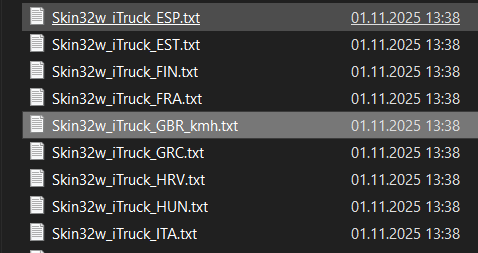
NextGen iGO_Israel_9.18.27.955559 - Skin32w_iTruck_GBR_kmh.txt - Not correct
_______________________________
Another reminder for build authors: if you are completing the content/speedcam folder and then publishing it to iGO users,
- users won't have a choice; you need to create the package correctly.
- iGO Nextgen 32-bit, the speedcam.txt file for the UK:
- or iGO Nextgen 64-bit (v9.35.2), the speedcam.txt file for the UK:Skin32w_iTruck_GBR_mph.txt
Skin32w_iTruck_GBR_kmh.txtLast edited by Andrey Form; 23rd November 2025 at 12:14 PM.
[Only registered and activated users can see links. ]
[Only registered and activated users can see links. ]
[Only registered and activated users can see links. ]
[Only registered and activated users can see links. ]
[Only registered and activated users can see links. ]
[Only registered and activated users can see links. ]
©AF_2020-26
-
26th November 2025, 01:41 PM #277Member
- Join Date
- Sep 2015
- Location
- Poland
- Posts
- 14
- Rep Power
- 0
I used spc speedcams for many years but I read here that they are always outdated. So it's better to remove spc speedcams and use txt files, for example from here: [Only registered and activated users can see links. ] right?
I see that in many skins speedcams are already included in txt format, pongo skins use VB version and wal24 skins use NC version.
My question, do I need to replace speedcam.zip (and speedcam_mod.zip in pongo skin) with latest Mod AF version?
Secondly, there are VB and NC version of this mods for both pongo and wal24 skins. Does it mean I can switch from VB to NC encoding in pongo skin or from NC to VB encoding in wal24 skin by replacing speedcam.zip in ux folder? Any advantages of NC encoding over VB or VB over NC?
-
26th November 2025, 03:03 PM #278SUPER MODERATOR
- Join Date
- Oct 2019
- Location
- Belarus
- Posts
- 3,786
- Rep Power
- 2751
@Brucie
If you change the file
speedcam_mod.zip - This file changes if you want to change the encoding or icons.
hen change the kit and this file.
speedcam.zip - This file must match the skin version, according to the release date.
Wal24 skin - Not all files are duplicated for this skin, as each version requires modifications to speedcam.zip. The speedcam.zip - speedcam_mod.zip bundle significantly simplifies modifications, as only one speedcam.zip file needs to be modified, as is the case in the Pongo skin.
VB - coding for passenger cars
NC - for Truck
I don't see much of a difference between using one encoding or another. For some countries, VB is implemented very well.
[Only registered and activated users can see links. ]
[Only registered and activated users can see links. ]
[Only registered and activated users can see links. ]
[Only registered and activated users can see links. ]
[Only registered and activated users can see links. ]
[Only registered and activated users can see links. ]
©AF_2020-26
-
27th November 2025, 10:05 AM #279Member
- Join Date
- Sep 2015
- Location
- Poland
- Posts
- 14
- Rep Power
- 0
1. Is there any difference between speedcam.zip from you and original speedcam.zip included in pongo skin?
2. Let's say I want NC speedcams for pongo skin from here: [Only registered and activated users can see links. ]
I replace speedcam.zip from here: [Only registered and activated users can see links. ] and speedcam_mod.zip from here: [Only registered and activated users can see links. ] ?
I can also use speedcam_mod.zip from here: [Only registered and activated users can see links. ] (only difference is icons?)
3. Let's say I want VB speedcams for wal24 skin from here (iGO World): [Only registered and activated users can see links. ]
I replace speedcam.zip from here: [Only registered and activated users can see links. ] ?
4. What if I'm using iGO for both car and truck navigation? I need to manually switch between NC and VB speedcams?
-
27th November 2025, 10:10 AM #280SUPER MODERATOR
- Join Date
- Oct 2019
- Location
- Belarus
- Posts
- 3,786
- Rep Power
- 2751
Please note that iGO defaults to a 20-degree azimuth offset, but this can be increased when writing to SYS. Optimal for use with the OSC 25-30 base.
The OSC base may have a slight azimuth deviation from the main road, which is noticeable on difficult sections, road curves, and at crossings. We are, of course, aware of this issue and verify all points users enter on the map.
Now that your navigator's alert angle is much higher, we can talk about the database as a whole.[warning]
Speedcam_max_angle=30
The database contains a wealth of information on the map, which is constantly changing, including speeds and radar installation locations. The database is open for editing; all you need to do is make changes to the map.
France's radars have a special history.
All known radars have been added to the OSC database. This applies to stationary radars. Now about radars—trailers on wheels—they're certainly not tripods, but they're not stationary either. Trailers are moved from one location to another, and who can track all their movements and mark them as active radars? These trailers are designated as code 1 in all databases—stationary radars. You receive a notification when the trailer isn't there; it might be installed 100 meters from where you're passing, or it might be there tomorrow. This shouldn't affect the database rating; it's important to understand that these trailers were designed to be untraceable.
Spoiler: +++++
Specifically in France, if you want to track trailer movements, then do it and make changes to the map. There was a problem with the "Radalerte" database before, as there was no one to make changes. Everyone just wants to use the ready-made speedcam.txt files without doing anything to improve the data.
Now about the stationary radars that were vandalized, again France is the main generator of these actions. Who will collect information about what burned and what was painted over, who will mark it on the map? Who will have information about how long it will take to repair or replace a radar? In any case, all fixed radars are marked as operational in the database. I don't see the point in marking a fixed radar as out of service for a week or two.Last edited by Andrey Form; 27th November 2025 at 10:27 AM.
[Only registered and activated users can see links. ]
[Only registered and activated users can see links. ]
[Only registered and activated users can see links. ]
[Only registered and activated users can see links. ]
[Only registered and activated users can see links. ]
[Only registered and activated users can see links. ]
©AF_2020-26


Bookmarks